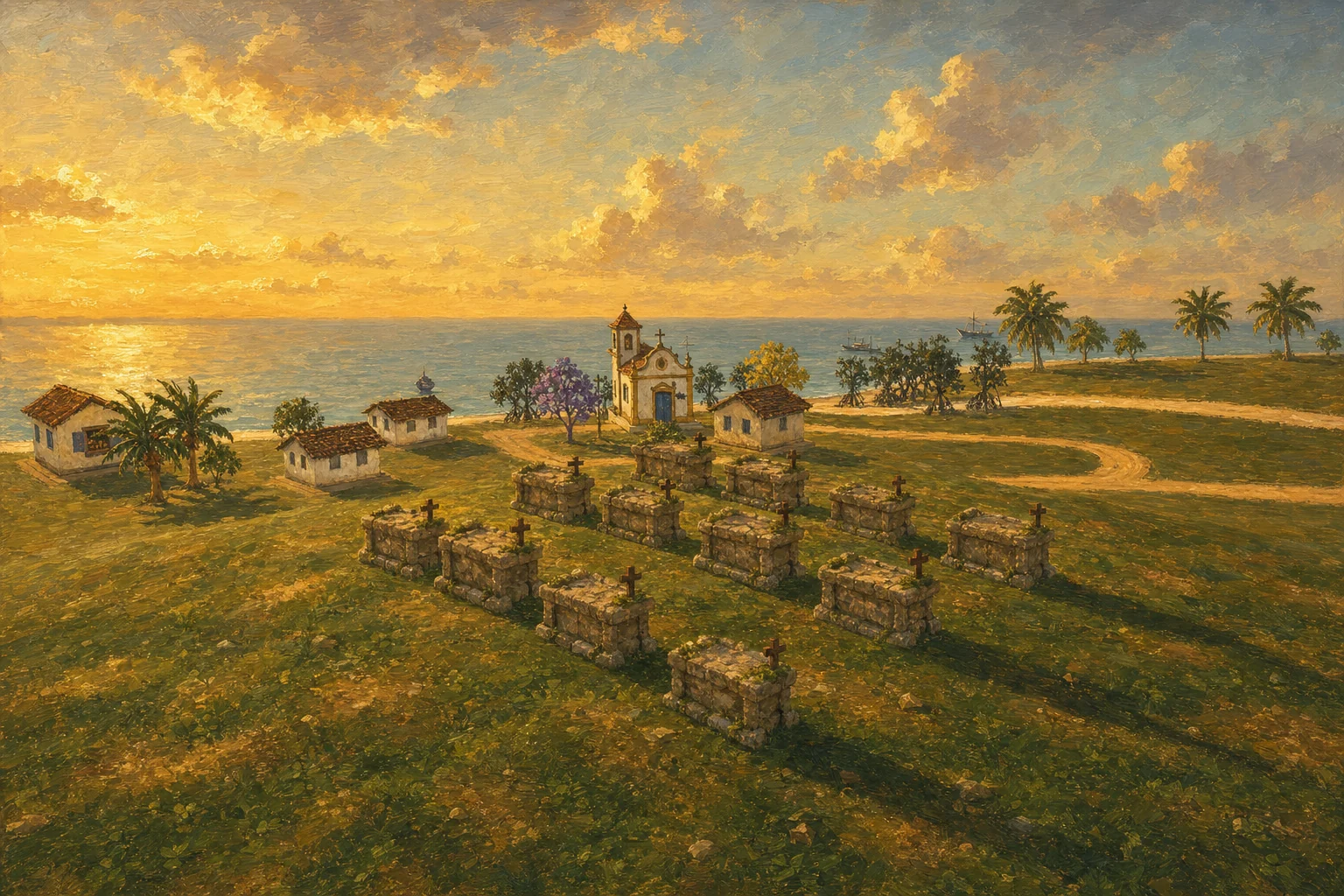
The notebook where the game keeps what you find on foot: trees with their entries, creatures that warn before they bite, cordel poems pinned to shop counters, signs of myths by the riverbank and the names of those buried in the cemetery.
26trees with entries
12animals in the fauna
10cordel poems to find
12headstones in the cemetery
7cards of myths and people
12almanac notes
80 Tripo models
The Recôncavo's forest, tree by tree
Backyard fruit trees, Atlantic Forest, mangrove and restinga. Every species with an almanac entry has its own model in the valley.
Drag to turn · scroll to zoom
Loading model…The model could not be loaded. Please try again.
Named tree near the player: four mango trees around the village and one on the Farm's plot, plus the mango-tree comparison bench south of the Square.
The prompt used in Tripo
One mature mango tree (Mangifera indica) as a stylized game prop: short thick dark-brown trunk, very wide dense dark-green rounded canopy casting deep shade, a few small yellow-green mangoes hanging, exposed root flare, isolated single tree, clean silhouette, no ground plane, no text.
8 species
Backyard fruit trees
What you eat and what gives shade around the house.
Mango tree
Mangifera indica
It came from India with the Portuguese and took so well to the Recôncavo that it seems native. A closed, dark canopy, cool shade all year round.
In the valley: Four named mango trees around the Square and one in the yard of the plot, beside the wattle-and-daub house. It is the yard's shade: the widest and the darkest.
Jackfruit tree
Artocarpus heterophyllus
Another one that came from Asia and took over. The jackfruit grows stuck to the trunk and can weigh more than ten kilos.
In the valley: Two named jackfruit trees near the Square, one to the southwest and one to the northeast.
Cashew tree
Anacardium occidentale
A native tree, crooked and sprawling, that likes sand and sun. The cashew apple is the stalk; the nut is the true fruit.
In the valley: Two cashew trees near the Square and two in the plot, crooked and sprawling, the way it likes sand and sun.
Banana plant
Musa × paradisiaca
It isn't a tree: it's a giant herb. The trunk is made of rolled-up leaves; after it bears its bunch, the plant dies and another sprouts beside it.
In the valley: Four clumps in the backyard of the wattle-and-daub house, on the plot.
Surinam cherry (pitanga)
Eugenia uniflora
No Bahian backyard is without one: a shrub with small, fragrant leaves that come out reddish.
In the valley: In the backyard of every house in the village, behind the house, as in Bahian backyards.
Genipap tree
Genipa americana
A tall tree with a smooth, straight trunk, which loses its leaves for a while and blooms in white and yellow.
In the valley: In the mix of the deep forest.
Guava tree
Psidium guajava
A tree with a smooth, twisted trunk whose bark peels off in plates, revealing pale wood beneath. It grows on its own in backyards, where birds drop its seeds.
In the valley: In the valley's landscaping zones and vegetation patches.
Papaya tree
Carica papaya
More herb than tree: a soft, hollow trunk without branches, star-shaped leaves high above and papayas clinging beneath them. It grows quickly and lives only a few years.
In the valley: In the valley's landscaping zones and vegetation patches.
12 species
Inland forest
What stands where the axe hasn't reached yet.
Brazilwood
Paubrasilia echinata
Red wood inside, bark with thorns. It gave the country its name and nearly vanished from the forest from being cut so much.
In the valley: Just one, west of the Square. By 1887 it's rare to find one still standing — and in the valley, one is standing.
Yellow ipê (trumpet tree)
Handroanthus albus
It goes unnoticed for months and, at the end of the dry season, drops its leaves and is covered all over in yellow flowers.
In the valley: One west of the Square and one in the churchyard, on the east side. In bloom all year round in the model.
Pink ipê (trumpet tree)
Handroanthus impetiginosus
Cousin of the yellow one, it blooms before it, in purplish pink. Old pink ipê trees mark chapel yards and roadsides.
In the valley: One southeast of the Square and one in the churchyard, on the west side.
Embaúba (trumpet tree, Cecropia)
Cecropia pachystachya
Hollow trunk, large hand-shaped leaves, silvery underneath. It is among the first to grow where the forest has been cleared.
In the valley: One named northeast of the Square and thousands in the deep woods: it is one of the species in the woodland mix and the dominant one along the edges of the streets.
Sapucaia (monkey pot tree)
Lecythis pisonis
A giant of the Atlantic Forest. In spring the whole canopy turns pink with new leaves; the fruit is a wooden bowl with a lid.
In the valley: The tall tree of the deep forest: two in every five trees drawn for the forest, with buttress roots and a high canopy (GLB mata_a).
Gameleira (strangler fig)
Ficus gomelleira
A wide-crowned fig with roots that come down from the branches and embrace whatever they find. A single one shades a whole square.
In the valley: The wide tree of the deep forest: two in every five trees drawn for the forest, round and dense canopy (GLB mata_b).
Ice-cream bean tree (ingá)
Inga sp.
A riverbank tree: its wide canopy shades the water and its roots hold the bank in place.
In the valley: Along the riverbanks, upstream, where the water stops being salty.
Jatobá
Hymenaea courbaril
A broad, dense crown above a thick, straight trunk. In lowlands with deep soil, it forms jatobá groves, one crown touching the next.
In the valley: In the valley's landscaping zones and vegetation patches.
Jequitibá
Cariniana legalis
King of the woods: it rises straight and thick, branchless for tens of meters, and lives for more than five hundred years. Those who enter its shade speak softly.
In the valley: In the valley's landscaping zones and vegetation patches.
Massaranduba
Manilkara huberi
A tree with a high, dark crown that takes a century to mature. When cut, it leaves white, sticky sap on the stump.
In the valley: In the valley's landscaping zones and vegetation patches.
Angico
Anadenanthera colubrina
A sparse, flattened crown and tiny leaves that close at dusk. It favors dry, rocky hills, where few trees can withstand the wind.
In the valley: In the valley's landscaping zones and vegetation patches.
Aroeira
Schinus terebinthifolia
A low, leafy tree whose crushed leaves smell of resin. It withstands sun, wind and poor soil, spreading over hilltops and woodland edges.
In the valley: In the valley's landscaping zones and vegetation patches.
4 species
Water's edge
The fringe of the bay, the mangrove and the sand.
Coconut tree
Cocos nucifera
The whole shore of the bay is fringed with coconut palms, leaning toward the sea as if looking for the water.
In the valley: The whole shoreline: a coconut palm every ~34 m along the coastline, 6 to 14 m from the water, leaning toward the sea. Two more named ones between the pier and the Square. It is the only tree that can be cut.
Red mangrove
Rhizophora mangle
It stands with its feet in salty mud, propped on roots that come down from the trunk like spider legs. Where the river meets the bay, it is in charge.
In the valley: Mangrove swamp along the riverbanks near the mouth and along the coast on both sides of each mouth, its feet in salty mud.
Autograph tree (Clusia)
Clusia sp.
A restinga shrub with leaves as thick as leather, which withstand the sun, salt and wind of the beach.
In the valley: Low restinga along the shore, among coconut palms, tropical almonds and piassava palms.
Bamboo
Bambusa vulgaris
A dense clump growing beside rivers, where the soil is damp. Each stem rises straight, hollow and jointed; at night the clump cracks and groans in the wind.
In the valley: In the valley's landscaping zones and vegetation patches.
2 species
Of field and trade
What becomes oil, brooms and ship's rope.
Oil palm (dendê)
Elaeis guineensis
A palm that came from the coast of Africa along with the enslaved people. The bunches of small red nuts grow in the middle of the crown.
In the valley: One named oil palm northwest of the Square and two beside the Venda do Bar.
Piassava palm
Attalea funifera
A palm of the Bahian restinga, its trunk dressed in long, dark fiber.
In the valley: In the mix of the deep forest and in the restinga along the shore, among the coconut palms.
4 species
Other plants in the valley
Tropical almond trees, shrubs, tall grass and understory plants fill the landscape; these plants do not yet have entries in the game's almanac.
Tropical almond (beach almond)
Terminalia catappa
Along the shore, mixed in with the coconut palms, as in the real village (photos of the place). Tiered canopy.
Flowering shrub
A ring of flowerbeds at the edge of the Square and the six clumps of mountain herbs at the lookout (Dona Zefa's quest).
Tall grass (sapê)
Four clumps around the cemetery graves: the brush Damião asks you to cut, which yields nothing.
Understory tuft (heliconias, bromeliads, ferns)
Under the deep forest, one tuft for every three trees; it disappears at 85 units from the camera.
From the forest, and they bite
They warn first; step aside and you walk away whole
Forest creatures telegraph their strike: the body glows amber, the head drops and a mark on the ground shows how far the bite reaches. Combat follows the same rules as the 2D game, number for number.
in the oil-palm forest and at the foot of the quarry
Collared peccary
A wild pig with a pale collar. It travels in small herds and isn't afraid of people: it's in a hurry.
It warns before it bites. It stops, lowers its head, and its body lightens; whoever gets out of the way then gets out whole.
Three blows of the machete bring one down. It leaves meat, which goes on the embers.
When one falls, the forest takes 3 days to put another in its place.
Goal: Pedro is keeping something of his father's for whoever brings down ten.
in the valley
on the crag, past the footbridge
Jaguar
The mistress of the crag. Spotted with rosettes, not stripes, and bigger than she looks from afar.
She warns only once and leaps from far away: her lunge reaches whoever thought they were already clear.
She moves faster than a person walks and slower than one runs. Whoever runs escapes; whoever walks doesn't.
At the counter her hide is worth as much as four game kills. When she falls, the crag stays empty for 5 days.
Goal: They say in the village that Dona Zefa sews an amulet for whoever brings down two.
in the valley
in the marshes: the eastern one, by the sea, and the one by the lagoon
Jararaca
A marsh snake, brown, with a dark pattern along its back. It lies coiled in the tall grass and chases no one: it waits.
The strike is short and quick; the body lightens first. The bite itself is minor.
What kills is what stays: the venom keeps draining life afterward, slowly, and the bar darkens to green. Leaf tea stops it.
Two machete cuts bring one down. It leaves its fat, which is a healer's remedy. When one falls, the marsh takes 4 days to have another.
planned
12 animals
Who else roams the valley
from the forest, and they bite
A wild pig with a pale collar. It lives in the valley's deep forest, picks up the player's scent within one radius and gives up beyond a larger one, winds up its lunge before biting and leaves game meat. Three blows of the machete bring one down; the forest replaces it in 3 days.
in the valley
Collared peccary
from the forest, and they bite
A wild pig with a pale collar. It lives in the valley's deep forest, picks up the player's scent within one radius and gives up beyond a larger one, winds up its lunge before biting and leaves game meat. Three blows of the machete bring one down; the forest replaces it in 3 days.
It catches the scent at 96 px in the 2D and only gives up at 176: once it has your scent, the only way out is really leaving.
Winds up its lunge for 0.75 s: its body lights up amber, it crouches to 72% of its height, and a mark on the ground shows how far the bite reaches.
It moves at 74% of the player's pace — you can escape by walking fast.
Whoever brings it down catches their breath: 4 stamina restored.
from the forest, and they bite
The spotted and black jaguars each live in their own crag. They see within a cone with a clear line of sight, detect scents behind them, warn and attack; outside their territory, they return to the shelter. The black jaguar emerges at dusk.
in the valley
Spotted jaguar
from the forest, and they bite
The spotted and black jaguars each live in their own crag. They see within a cone with a clear line of sight, detect scents behind them, warn and attack; outside their territory, they return to the shelter. The black jaguar emerges at dusk.
Health 36, bite of 8, 0.7 s lunge with an 18 px leap.
Her lair is in a rock shelter on a stony hill, not in a hole in the ground — that's why she stays on top of a crag.
When it falls, the crag stays empty for 5 days; bringing it down restores 12 stamina.
from the forest, and they bite
A marsh snake, brown, with a dark pattern. It doesn't chase: it waits coiled in the tall grass. The bite is minor; what kills is the venom, which drains life slowly for 12 s. Leaf tea stops it.
planned
Jararaca
from the forest, and they bite
A marsh snake, brown, with a dark pattern. It doesn't chase: it waits coiled in the tall grass. The bite is minor; what kills is the venom, which drains life slowly for 12 s. Leaf tea stops it.
Health 8, bite of 2, short 0.55 s strike; pace 48% of the player's.
Venom: 0.5 health per second for 12 s; the bar darkens to green.
Two machete cuts bring one down; the marsh takes 4 days to have another.
from the sea
It patrols deep water, hunts fish and chases anyone swimming far from shore; when it catches the traveler, they return to dry land.
in the valley
Shark
from the sea
It patrols deep water, hunts fish and chases anyone swimming far from shore; when it catches the traveler, they return to dry land.
It lives in water 1.8 units (7.2 m) deep or more; it chases from 1.6 u and never enters less than 1.0 u: whoever heads back to the sand escapes.
Patrols at 1.1 u/s; when chasing it goes 2.3 u/s (the player swims at ~1.5, running 3.0). It senses at 55 units.
On reaching you (0.9 u): screen effect, attack sound, and the player is returned to solid ground. Then it rests for 25 s.
At low tide, with no deep water at the fishing ground, it sinks and disappears until the water returns.
It isn't a creature you fight and has no page in the creature notebook: it doesn't fall and doesn't leave anything.
from the sea
Mullets and sardine bait balls near the canoes, hunting jacks, sergeant majors and parrotfish around the rocks, piabas, acarás and Traíra in the pools; mackerels, Spanish mackerels and rays offshore. They flee swimmers and predators.
in the valley
Pier school of fish
from the sea
Mullets and sardine bait balls near the canoes, hunting jacks, sergeant majors and parrotfish around the rocks, piabas, acarás and Traíra in the pools; mackerels, Spanish mackerels and rays offshore. They flee swimmers and predators.
A ring with a 4.5 u radius at 0.9 u/s; flees at 2.2 u/s from anyone passing within 3 u.
Fixed seed 1887: the school is always the same.
With less than 0.3 u of water at the center, it disappears into the depths.
Line cast within 6 u of the center: 'Line in the school. Wait for the bite...'
Tripo fish (itens/peixe_tripo.glb).
fishing (sea)
The fish of the Bay of All Saints. Only in salt water: 16 in 100 casts. It's the one that brings money — worth three common fish at the general store counter.
in the valley
Snook
fishing (sea)
The fish of the Bay of All Saints. Only in salt water: 16 in 100 casts. It's the one that brings money — worth three common fish at the general store counter.
Sea pool: common fish 46, two fish 20, snook 16, nothing 18 (weights out of 100).
fishing (fresh water)
A backwater fish. Only in fresh water: 20 in 100 casts. Less money than the snook and more than a common fish — worth two.
in the valley
Trahira
fishing (fresh water)
A backwater fish. Only in fresh water: 20 in 100 casts. Less money than the snook and more than a common fish — worth two.
Freshwater pool: common fish 48, two fish 14, trahira 20, nothing 18 (weights out of 100).
fishing (any water)
In all water, on purpose: half the kitchen recipes call for fish. Fishing is one key: E casts, the wait is 1.6 to 5 s, and there's a 0.75 s window to set the hook when the bobber sinks. Walking reels in the line.
in the valley
Common fish
fishing (any water)
In all water, on purpose: half the kitchen recipes call for fish. Fishing is one key: E casts, the wait is 1.6 to 5 s, and there's a 0.75 s window to set the hook when the bobber sinks. Walking reels in the line.
Stamina per cast: 2.
Whoever misses the window: 'The line came back empty' or 'It took the bait and left'.
bird (song only)
In the morning and afternoon, a short call comes from a point 15–30 units from the player, every 18 to 50 seconds, on the 'aves' volume layer. It has no body: the valley feels inhabited by ear.
in the valley
Great kiskadee
bird (song only)
In the morning and afternoon, a short call comes from a point 15–30 units from the player, every 18 to 50 seconds, on the 'aves' volume layer. It has no body: the valley feels inhabited by ear.
Two calls (bem_te_vi_1.mp3 and bem_te_vi_2.mp3), generated with ElevenLabs Sound Effects.
Silent at night.
soundscape
By day birds and insects; by night crickets, frogs and owls, crossfading with the daylight. Insects and crickets are shrill, so they come in short episodes (6–12 s) separated by pauses of 1 to 2.5 min. In the deep forest, sparse whispers and the tension track.
in the valley
Voices of the forest
soundscape
By day birds and insects; by night crickets, frogs and owls, crossfading with the daylight. Insects and crickets are shrill, so they come in short episodes (6–12 s) separated by pauses of 1 to 2.5 min. In the deep forest, sparse whispers and the tension track.
Sea at the pier, a stream at the two points on the river, the bonfire in the yard when lit — all by proximity.
domestic and local
Dogs follow their owners and sleep at doorways; cats flee them. Hens, roosters, chicks and guinea fowl return to the roost. Ducks swim in the stream; pigs, goats, a billy goat and a donkey roam their yards; peacocks live in the churchyard.
in the valley
Creatures from the art direction
domestic and local
Dogs follow their owners and sleep at doorways; cats flee them. Hens, roosters, chicks and guinea fowl return to the roost. Ducks swim in the stream; pigs, goats, a billy goat and a donkey roam their yards; peacocks live in the churchyard.
Routines by species and home, with an owner and a sleeping place.
The peacock spreads its tail when the player stops nearby.
Only the chicken coop in the player's yard, with three hens that each lay one egg a day, counts as productive animal husbandry; the rest is part of the scenery.
from the story
Not a creature: this is the Matinta Pereira of chapter 7 of the story. She appears only when the story calls for her, at the top of the chapel tower, when the sapphire spear strikes the shield, and the clash is a real fight.
in the valley
Barn owl, the 'shroud-tearer' (Tyto furcata)
from the story
Not a creature: this is the Matinta Pereira of chapter 7 of the story. She appears only when the story calls for her, at the top of the chapel tower, when the sapphire spear strikes the shield, and the clash is a real fight.
She appears when the spear strikes the shield at the top of the chapel tower, and fights near the ruins of the mansion.
She has 70 health against the sapphire spear; the shield withstands the bite.
The spirit of the farm's master walks beside the player and steps forward when she falters: she is left dazed for a few seconds.
She can be brought down only once, and she does not return with the passing days.
10 chapbooks pinned around the village
Cordel on the counter, by the well and on the chapel door
No chapbook is attributed to a real person: the 'autor' field describes the paper (unsigned chapbook, handwritten). In 1887 printed cordel had barely begun; what circulated in the Recôncavo was handwritten.
The False Weight
unsigned chapbook
A shopkeeper had a weight of lead, but hollow inside, it weighed half an arroba and he charged a whole one, and then some. He died, and that scale of his tips on its own, just a little.
On the general store counter, under the scale60 réis
The Dog Who Went to the Funeral
handwritten, no name
The dog went to the funeral behind his master's coffin, lay down on top of the grave and there he lost his sleep. They gave him meat, they gave him water — and all he wanted was his master.
In the chapel, under a pew70 réis
The Man Who Sold the Rain
unsigned chapbook
A man turned up at the market selling rain in bottles. The colonel bought three and paid with a herd of cattle. It rained that afternoon, by chance, and of the man, nothing more was heard.
In the beach bar, forgotten on a table55 réis
The Mass of the Drowned
wrapping paper, no type
On a night of east wind the chapel lights up again. Whoever peeks through the crack sees the pews filling up with people in wet clothes: they are the ones who stayed at sea.
In the cemetery, in an empty niche80 réis
The Girl Who Lived in the Water
unsigned chapbook
In the deep bend of the river where the water makes no sound there lives a girl with hair as long as a cotton boll's thread. Whoever calls, she answers. Whoever answers, is pulled under.
At the edge of the lagoon, pinned under a stone45 réis
The Fellow Who Went to the Farm
unsigned chapbook
He was invited to a party on a moonlit Saturday, went in through the iron gate and never came back again. They say he's dancing to this day and no one can wake him.
At the ford of the great river, under the fallen bridge90 réis
The Duel of the Caboclo and the South Wind
unsigned chapbook
The caboclo challenged the south wind to a duel: — You can knock my hat off, but you can't knock down the church. The wind laughed and blew and the church is still there, go and see.
At the lookout, up on the ridge50 réis
The Hollow Wooden Saint
unsigned chapbook
They carried the saint on the boat with gold inside its belly. The saint arrived empty and no one raised a fuss. Those who prayed didn't get rich, those who stole had no quarrel.
In the ruin of the manor house, among the stones75 réis
The Ox That Spoke at the Mill
unsigned chapbook
At the Colonel's sugar mill an oxcart ox spoke up. It said only: — I am tired. — and the cart moved no more. The Colonel sold the ox and the ox never came back.
At the sugar mill, hanging from a rafter45 réis
The Boy Who Fished the Moon
unsigned chapbook
The boy cast out his line on the full-moon tide, hooked the moon right through the middle and dragged it across the sand. His mother told him to let it go: — Without the moon, the night is ugly.
At the end of the pier, inside a tin can40 réis
The title never names the myth
Signs from those who looked first
at the river's edge, where the water pools and stands still · in the afternoon, with the sun low
What looked back
You leaned down to drink and the face that floated up was not yours.
It was a woman's, and she was laughing — not at you, but at something she knew and you didn't.
It lasted the blink of an eye. Then the water went back to being water, and on the bank this was left: a strand of black hair, too long to belong to anyone in the village, wound around a stone the way you tie a message.
What the almanac reveals later
The strand was hers. Iara, the water maiden, the one who lives where the river stops.
She looked first. They always look first — that's how they choose.
in the deep forest beyond the great river · at midday, with no wind
The forest that stopped
The noise ended. It didn't fade: it ended, all at once, like someone shutting a door.
No creature, no leaf, no insect. You counted to ten and the forest started talking again, all together, as if nothing had happened.
On the ground, in the middle of the clearing, a single footprint. A human foot, a child's, and turned backward.
What the almanac reveals later
The backward footprint is the signature of the Caipora, who walks backward toward whoever follows her.
She wasn't hiding. She was watching you count to ten.
deep in the forest, far from any path · at any hour, with the forest gone quiet
Footprints the wrong way round
A child's footprints, one after the other, deep in the thick brush where nobody goes.
The toes point backwards: whoever left them walked one way with their feet turned the other.
A thin whistle from nowhere. And the map, which you always knew how to read, no longer knew where north was.
Pacts
2
With a myth, at its place. It gives a permanent gain and charges every day at dawn. One at a time: sealing a second undoes the first. Whoever has nothing to pay with doesn't lose the pact — they lose that day's gain, and are told so.
Caipora's Pact — The forest lets you carry more. Every night before dawn she charges her toll — we have no tobacco, so it's food.
Iara's Pact — The water gives what it has. She charges in something sweet, every day, and won't take fish — fish are hers.
Support
2
A card of people, not of myth. It can be used once a day, on the B key, and costs nothing: it is a favor kept in reserve, a prayer someone taught you.
Dona Zefa's strong prayer — Once a day: your body holds out for the rest of the afternoon.
Cosme's Arm — Once a day: he shows up and helps with any heavy lifting.
Rituals
3
A consumable prepared at the home altar with what you grow. It's gone once used. It's the only one of the three the player makes.
Rain call — Waters the whole plot, right now. What was dry wakes up grown.
Field ward — For three days, every harvest yields one more.
Eye of the forest — Points out what the forest has nearby: hardwood and good stone.
Damião keeps watch, the almanac remembers
12 names the village has not forgotten
1801 – 1869
Midwife for forty years. Brought half the village into the world and never charged those who had nothing.
Maria das Dores Conceição
1801 – 1869
Midwife for forty years. Brought half the village into the world and never charged those who had nothing.
1822 – 1858
He went out in a canoe in a strong northeaster and the sea didn't give him back. Here lies his net.
Joaquim Pescador
1822 – 1858
He went out in a canoe in a strong northeaster and the sea didn't give him back. Here lies his net.
1830 – 1884
Prayer healer. She cured the evil eye with rue; to this day people leave green leaves on the stone.
Ana Rosa do Espírito Santo
1830 – 1884
Prayer healer. She cured the evil eye with rue; to this day people leave green leaves on the stone.
1815 – 1872
Saveiro master. He carried flour to Salvador and brought back news of the world.
Benedito Firmino
1815 – 1872
Saveiro master. He carried flour to Salvador and brought back news of the world.
1861 – 1866
Taken by the fever in the year of the drought. The jasmine her mother planted still blooms in September.
Luzia, a girl
1861 – 1866
Taken by the fever in the year of the drought. The jasmine her mother planted still blooms in September.
1790 – 1856
The chapel's first priest. He asked to be buried facing the sea, not the altar.
Padre Inácio Moura
1790 – 1856
The chapel's first priest. He asked to be buried facing the sea, not the altar.
1812 – 1880
She bought her freedom selling cocada at the market. With what was left, she bought her sister's.
Felícia da Purificação
1812 – 1880
She bought her freedom selling cocada at the market. With what was left, she bought her sister's.
1826 – 1879
He made the chapel doors and almost all of these crosses. His own, his son made crooked, as a tribute.
Manoel Carpina
1826 – 1879
He made the chapel doors and almost all of these crosses. His own, his son made crooked, as a tribute.
1840 – 1882
Twins who passed on the same day. In the village, no one remembers one without speaking of the other.
Custódia and Custódio
1840 – 1882
Twins who passed on the same day. In the village, no one remembers one without speaking of the other.
1833 – 1877
He played the viola at the samba de roda until daybreak. When the wind blows from the forest, some still hear his picking.
Sebastião Violeiro
1833 – 1877
He played the viola at the samba de roda until daybreak. When the wind blows from the forest, some still hear his picking.
1818 – 1885
She planted the valley's first manioc field. The flour house still uses her oven.
Dona Zefa do Roçado
1818 – 1885
She planted the valley's first manioc field. The flour house still uses her oven.
? – 1874
He arrived on a raft with no sail, already lifeless. He was given flowers and a cross like a son of this land.
Unknown
? – 1874
He arrived on a raft with no sail, already lifeless. He was given flowers and a cross like a son of this land.
They appear in the menu, over the valley
Almanac notes
The valley's sea follows the Navy's nautical chart 1108, with the water at spring-tide high water.by day
The whole shore of the bay is fringed with coconut palms, leaning toward the sea as if looking for the water.by day
In 1887 piassava leaves Bahia in bales for the whole world: it becomes brooms, ship's rope and roofing for huts.by day
Where the river meets the bay, the red mangrove is in charge, standing in salty mud.by day
The oil palm came from the coast of Africa; from the dendê comes the oil of acarajé, vatapá and moqueca.by day
By 1887 it's rare to find a brazilwood tree still standing in the forest.by day
Green jenipapo stains the skin dark blue for days; ripe, it becomes the liqueur of the São João festivals.by day
He also said, without taking his hand off the tiller, that out here you learn not to walk in the forest after dark.by night
My grandmother says that whatever trades with us at night collects by day. — Pedroby night
For followers of Candomblé, the gameleira is the dwelling of Iroko, and it is not cut. The elders keep well away from it at night.by night
At high tide, nobody walks in the mangrove.by night
Nobody sleeps under a laden jackfruit tree.by night