
Direction · 5 of 7
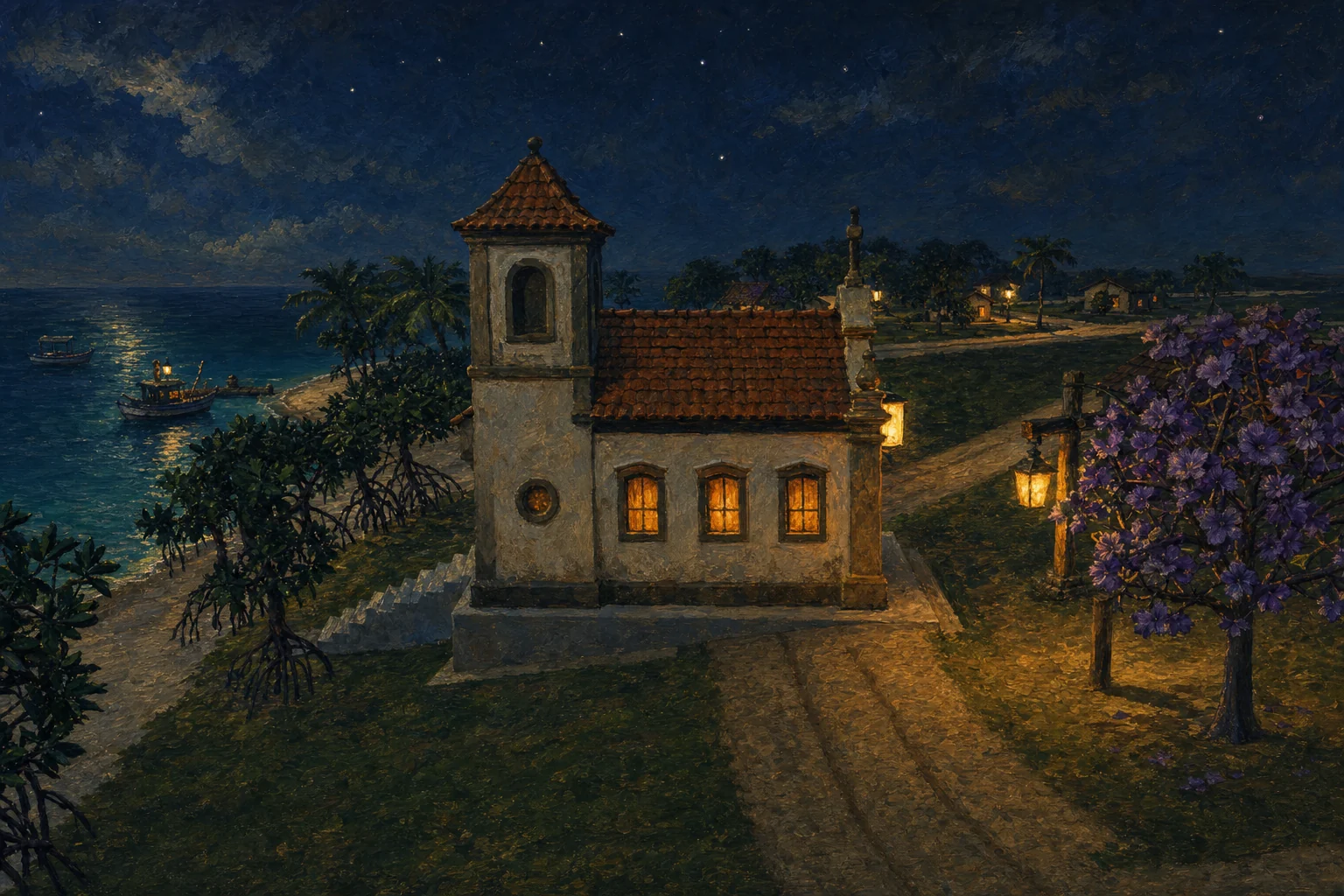
Bom Jesus dos Pobres in 1887 is a fishing village on the eve of Abolition — and anyone from the Recôncavo has to recognize the place.
The story takes place in Bom Jesus dos Pobres, in Bahia's Recôncavo, around 1887: a small hamlet between streams, on the shore of the Bay of All Saints and surrounded by Atlantic Forest. The date is chosen, not decorative: it's the immediate eve of Abolition (the Law of the Free Womb dates from 1871, the Sexagenarian Law from 1885, Abolition will come in 1888), the Recôncavo's sugar has already lost out to the Antilles and to the Southeast, the sugar mill is broken and the big house is falling down. Decline is the mood. Quilombos exist, are known, and are a real destination for escape.
The setting document is the project's visual and narrative contract: every new asset goes through it before getting in. The goal isn't a museum reconstruction: it's that people from the Recôncavo recognize the place. The narrative's primary source is chapters 6 and 7 of the Batalha de Mitos universe, of which the game is a spin-off; the player arrives by boat, heir to a wattle-and-daub house and a field, and is welcomed at the pier by Pedro Nolasco da Encarnação, a fisherman in his early twenties who knows how to fish, farm and live — and who doesn't know about the myths.
Historical and narrative direction
Bom Jesus dos Pobres in 1887 is a fishing village on the eve of Abolition — and anyone from the Recôncavo has to recognize the place.
The story takes place in Bom Jesus dos Pobres, in Bahia's Recôncavo, around 1887: a small hamlet between streams, on the shore of the Bay of All Saints and surrounded by Atlantic Forest. The date is chosen, not decorative: it's the immediate eve of Abolition (the Law of the Free Womb dates from 1871, the Sexagenarian Law from 1885, Abolition will come in 1888), the Recôncavo's sugar has already lost out to the Antilles and to the Southeast, the sugar mill is broken and the big house is falling down. Decline is the mood. Quilombos exist, are known, and are a real destination for escape.
The setting document is the project's visual and narrative contract: every new asset goes through it before getting in. The goal isn't a museum reconstruction: it's that people from the Recôncavo recognize the place. The narrative's primary source is chapters 6 and 7 of the Batalha de Mitos universe, of which the game is a spin-off; the player arrives by boat, heir to a wattle-and-daub house and a field, and is welcomed at the pier by Pedro Nolasco da Encarnação, a fisherman in his early twenties who knows how to fish, farm and live — and who doesn't know about the myths.
10 principles
What is not negotiable
1887 is a chosen date
The immediate eve of Abolition: the country is at the height of the slavery crisis, but it hasn't yet reached the isolated interior of the Recôncavo, where masters held captives even with emancipation laws in force. Sugar has already lost, the mill has broken down, the master is absent. What this dictates for the art: no colonial opulence in good repair — peeling whitewash, displaced roof tiles, weeds taking over the courtyard. What's new and well kept is the poor house of the people who work, not the manor.
A village, not a town
Bom Jesus dos Pobres was not a town in 1887 (and it doesn't have that status even today: it's a district of Saubara), but as a settlement, village and fishing village it already had more than 230 years of history — the chapel of Senhor Bom Jesus dos Pobres was built on February 25, 1652, and the point and its beaches served as trenches in the War of Independence (1822–1823). Documentation and dialogue strictly use the terms village, hamlet, settlement or fishing village; calling the place a "town" would be anachronistic.
Slavery doesn't become a mechanic
It doesn't become a resource or a number. It appears as what it is — people held captive who need to be freed — and in the main narrative, not in a game system. Black characters are not scenery or decorative victims: the women of chapter 7 drive the revelation and the final decision, and it's to a quilombo that they go.
The layout of the real place and pieces with a social function
The map follows the layout of Bom Jesus dos Pobres: sea to the south, forested hills to the north, the church at the shore, the cemetery on the slope, the square a little inland, the pier out into the sea, a stream running down through the middle of the village. And each piece exists because village life called for it: the washing tank (the women's meeting place), the communal clay oven (the flour house is for manioc), the trapiche (cargo needs somewhere to spend the night), the chicken coop, the roadside chapel, a terreiro in the forest reached by a one-tile path (in 1887 a terreiro that could be seen from the road was a terreiro the police shut down) and the gameleira of the sambaqui, the oldest landmark on the map. A piece with no yard and no path to it becomes a miniature on the lawn.
Pedro doesn't know about the myths
The tutorial guide is a fisherman in his early twenties who knows how to fish, farm and live in the village; he teaches what he knows, "which isn't much, but it's enough to live on." The supernatural comes in only when the story calls for it: the barn owl (Tyto furcata) is not an animal, it's the Matinta Pereira of chapter 7; the Caipora leaves a sign in the deep forest, and only after it do her cards appear. Myth and the supernatural come in luminous sapphire blue — and only they do.
The source is the book, and the content isn't rewritten
Chapters 6 and 7 of the Batalha de Mitos universe are the primary source; the visual references come from chapter 73 on the site. The 146 KB of dialogue, quests and plot written and revised for the 2D (Pedro's tutorial, the seven villagers, the village, the farm, the 22 works, cordel poems, animals and signs) migrate by wiring, not rewriting. Before writing new text, check whether the text already exists and just isn't getting through.
Everything is translated: Portuguese, English and Spanish
The author's decision: the game speaks all three languages, not just the menu; there is no player-facing text in only one language. Every text is born as data (campo, campo_en, campo_es in the same object), never as a GDScript constant, and the tests/idiomas.gd gate fails when a translation is missing or when it's a copy of the Portuguese. The translation is Ramon's: it's 58 KB of prose in a regional register ("Bora pro píer", "casa de pasto", "o pão desta terra"), which is not work for a machine translator. What's still missing is declared in FALTAM_TRADUCAO, with the reason. Chinese came later, in the menu and in the villagers' lines, and falls back to English where text is still missing.
Context guides; it doesn't label
The fact that the story takes place in Bahia's Recôncavo in 1887 guides the setting and lives in the documentation and the dialogue; the CONHECER screen presents credits and world in public language. The position annotated today, the role in the plot and the period representation are kept apart: a name observed today doesn't need to appear literally in a story set in 1887 (the KML's restaurant is, in 1887, the casa de pasto: dish of the day for a few réis, ordered at the stove).
A gift for Pedro Nolasco da Encarnação
The game is dedicated to the author's great-great-grandfather, documented in the family tree, who lived in Bahia's Recôncavo in 1887 — and who, in the game, is the fisherman who waits for the traveler at the pier and teaches the first steps. It is the project's answer to the Tripothon S1 theme ("A Gift for ____").
The story already crosses the river
Arrival, field, bridge, plateau, boulder, building site, faith, the yard and the farm are already playable, from the gate and courtyard to the night of the Matinta: the call to the brave and the narrow door (chapter 6), the windowless room, the flight to the ruins, the clash and the owl statue (chapter 7). The voice of the world tells what the valley does not build, such as the round hall and the quilombo.
7 rules
In practice, day to day
- Architecture in four types, and only four: whitewashed wattle-and-daub house with colonial roof tiles and solid shutters (no glass); two-story townhouse with an iron balcony and Portuguese azulejo; a long, low big house, abandoned inside even when people live there, with a low iron gate one meter high; working buildings (flour house, sugar mill, monjolo, pole corral, fishing hut on stilts). No half-timbering, dressed castle stone, steep roofs, brick chimneys, dark wooden cabins, or glass windows on poor houses.
- Flora of the Recôncavo's Atlantic Forest, not the Amazon or the cerrado: mango (the queen), jackfruit, cashew, dendê palm, coconut palm, ipê, brazilwood, embaúba; manioc is the absolute base of cultivation (extensive sugarcane fields were never part of Bom Jesus). The forest is dense and tall: the feeling is of not being able to see far.
- Fauna: loose billy goats and nanny goats, chickens, ox carts, a skinny dog; tanagers, sayaca tanagers, great kiskadees, egrets, swimming crabs and land crabs; and, among the ones that bite, peccaries in herds, a jaguar on the crag and the jararaca in the marshes. Jaguars den in rock shelters on stony hills, not in holes in the ground.
- Two seasons that matter more than the calendar's four: rain (April to August) and drought; the palette leans toward that pair — soaked green against dry ochre.
- Building upgrades are not a linear ladder: the outer shell has three stages (one-room wattle-and-daub → house with a veranda → azulejo-clad townhouse) and the interior is assembled piece by piece; an upgraded workshop is still whitewashed wattle-and-daub.
- All player-facing text in JSON, with _en and _es fields planned from birth; files not yet translated declare 'traducao': 'pendente'.
- Quest rewards are food, by tutorial rule: beiju, cocada, garapa, pirão, grilled fish, mungunzá — what the land and the sea provide.
Where it shows up
- The crossing (pedro.json)
Nine lines in three languages: the letter at the notary's office in Salvador that waited three months, the uncle who left a wattle-and-daub house and a field free of debt, the saveiro that left the Rampa do Mercado on the predawn tide, the boatmaster who points to the gap of sand between the coconut palms and warns that there you learn not to walk in the forest after dark. - The villagers' lines (npcs_3d.json)
Seu Benedito: "Forty-two harvests on this plateau, son. The land gets tired, and so do we." Each villager with a voice has their own lines, alternating at each encounter, in their own voice. - The almanac by day and by night (identidade.gd)
By day, facts the game itself tells ("In 1887, piassava leaves Bahia in bales for the world"; "In 1887, it's already rare to find a brazilwood still standing in the forest"); by night, what is said in the valley ("At high tide, nobody walks in the mangrove"; "Nobody sleeps under a jackfruit tree heavy with fruit"). - The invitation from the farm
"To the residents of Bom Jesus and its surroundings: come to the farm on the appointed day. There will be a great event, with plenty for all." There is no signature, only the red seal with no coat of arms. The journey leads to the farm gate and courtyard and continues through chapters 6 and 7, up to the Matinta Pereira. - The cemetery and the cordels
Twelve gravestones with short stories and ten cordels in the catalog. Six chapbooks are in the village: the store counter, old chapel, bar, cemetery, lookout and the end of the pier. The rest await placement at the lagoon, the bank of the great river, the ruins of the mansion and the sugar mill.
Where it comes from
The documents behind this area
- Setting — where, when and the valley's palette
- Game vision — what the game is and what it brings together
- Pedro's lines — the crossing and Pedro's script
- Residents — who lives in the valley and where
- Story — the authored chapters of the story
- Development history — the steps before the standalone repository
- Opening and audio — the crossing, the pier arrival and the opening sound
- Geographic map — the Google Earth drawing as reference
- In-game identity — colors, fonts and pieces of the Recôncavo Chronicle
- Tripothon entry — the project's submission texts